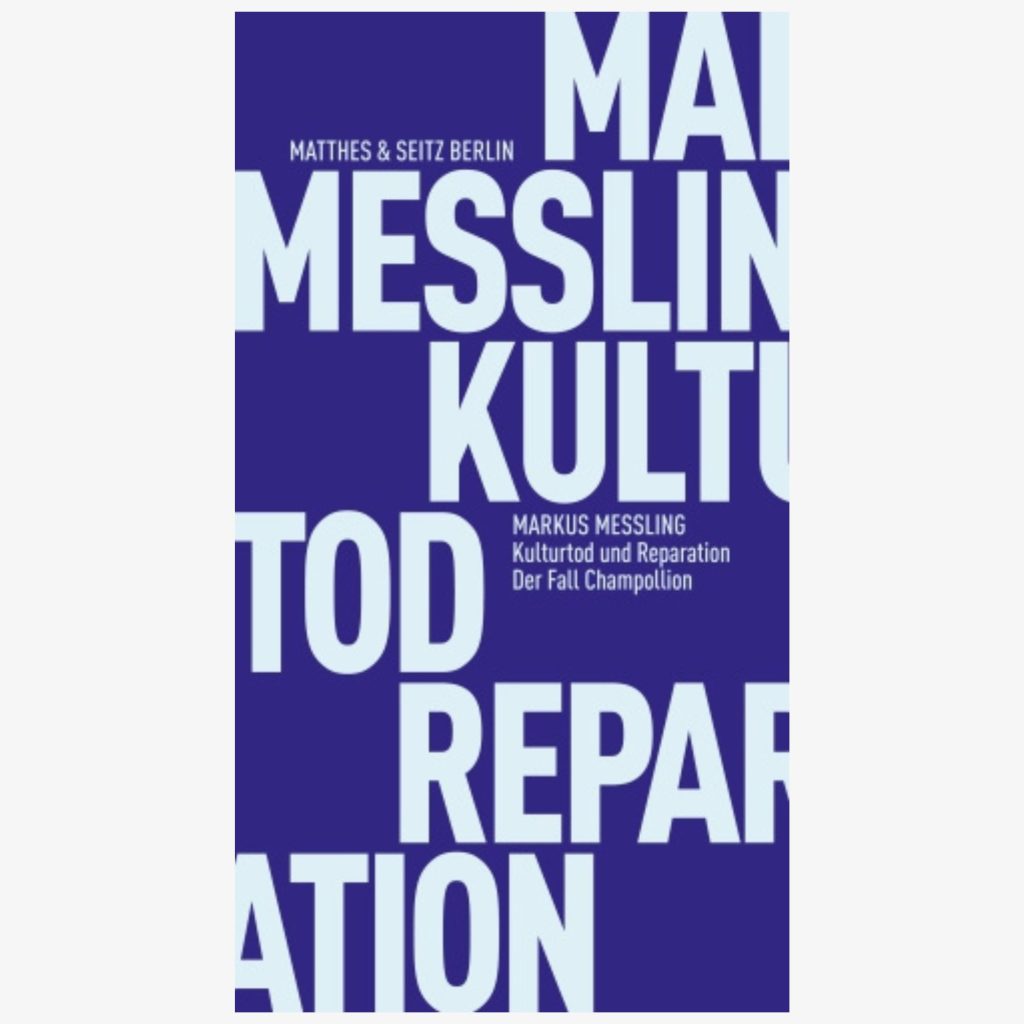
The Käte Hamburger Centre for Cultural Practices of Reparation (CURE) is launching a new publication series. Reparationen, edited by Markus Messling and Christiane Solte-Gresser, is published by Matthes & Seitz Berlin as part of its short-form book series Fröhliche Wissenschaft.
The series begins with the question of how the destruction of our world might be repaired. Genocides, the consequences of colonialism, traumas caused by wars, the extinction of languages and species, and global warming are all irreparable. And as crucial as material and legal efforts are in addressing injustice, they alone are not enough to open up a shared perspective on the future. Cultural practices of reparation, by contrast, work with and on the irreparable. In creating a space for complexity and a plurality of voices, they make it possible to explore how we might live with others. Rethinking and reshaping our relationship with the world through these practices is one of the great tasks facing Europe in its future.
The series appears within the short-form programme Fröhliche Wissenschaft, which explores major ideas, complex reflections, and thoughtful observations in sharp, concise form.
FIRST VOLUME OF THE SERIES
Markus Messling: Kulturtod und Reparation: Der Fall Champollion
(Cultural death and reparation: the case of Champollion)
Fröhliche Wissenschaft 267
Reparationen, vol. 1 (ed. Markus Messling and Christiane Solte-Gresser)
The visual semantics of the statue of Jean-François Champollion created by Frédéric-Auguste Bartholdi and installed in the Cour d’honneur of the Collège de France is fraught with contradictions. Intended as a heroic monument to the pursuit of knowledge, it is nonetheless overshadowed by tragedy. Champollion – celebrated for deciphering hieroglyphs – was deeply shaped by encounters with the destructive forces of colonialism, both in Paris, where he met members of the Osage Nation, and during his travels in Egypt. These experiences were closely connected to the global awareness that made his rise to prominence possible. Champollion’s doubts and deeds raise questions that Markus Messling explores in his reflection on the social foundations of contemporary Europe.
“In Cultural Death and Reparation, Markus Messling poses a fundamental question: Such as the world is now, how should we imagine the form of universality as an ethical claim, an epistemic perspective, a political project? Universality, he insists, is the enigma we cannot afford to forsake. Reading Frédéric-Auguste Bartholdi’s statue of Jean-François Champollion installed in the Courtyard of Honor at the Collège de France as an allegory of enlightenment, an ambiguous witness to empire’s evils, a monument to the entanglement of knowledge and doubt, Messling responds that only an idea of universality imagined as a tragic virtue can adequately attune us to the obligations and responsibilities of the present.”
— David Scott (Columbia University)
Markus Messling is professor of Romance literatures and comparative literary and cultural studies at Saarland University and director of the Käte Hamburger Centre for Cultural Practices of Reparation (CURE).