Europe’s challenging task for the future is to reshape its relationship with the world. Today, shared perspectives can no longer be achieved solely through the investment of more technology, money or natural resources, but arise primarily from reparative processes. However, the greatest destruction and wounds – such as genocide, trauma caused by war, destroyed cultural commons, the consequences of global warming, and the extinction of species and languages – are irreparable. Material and legal compensation processes are indispensable here, but they are not enough on their own. Cultural practices of reparation, by contrast, work with and on the irreparable. Their significance lies in their capacity to create complexity, ambiguity, and polyphony, opening ways to explore, experience, and transform the tension between irreparable destruction and the necessity of continuing to live.
The new open-access series Cultural Reparations, published by the Käte Hamburger Centre CURE, has grown out of this research perspective. Edited by Markus Messling and Christiane Solte-Gresser and published by De Gruyter|Brill (Berlin, Boston), the series provides a forum for research on cultural practices of reparation emerging from the centre and its wider context. It includes monographs and edited volumes featuring contributions from the CURE symposia and other scholarly events organised by the centre, with an editorial board comprising the internationally leading scholars who serve on the centre’s Academic Advisory Board. Volumes are published in English, French, Spanish, or German, or may be multilingual.
Link to the publication series
The following volumes have recently appeared:
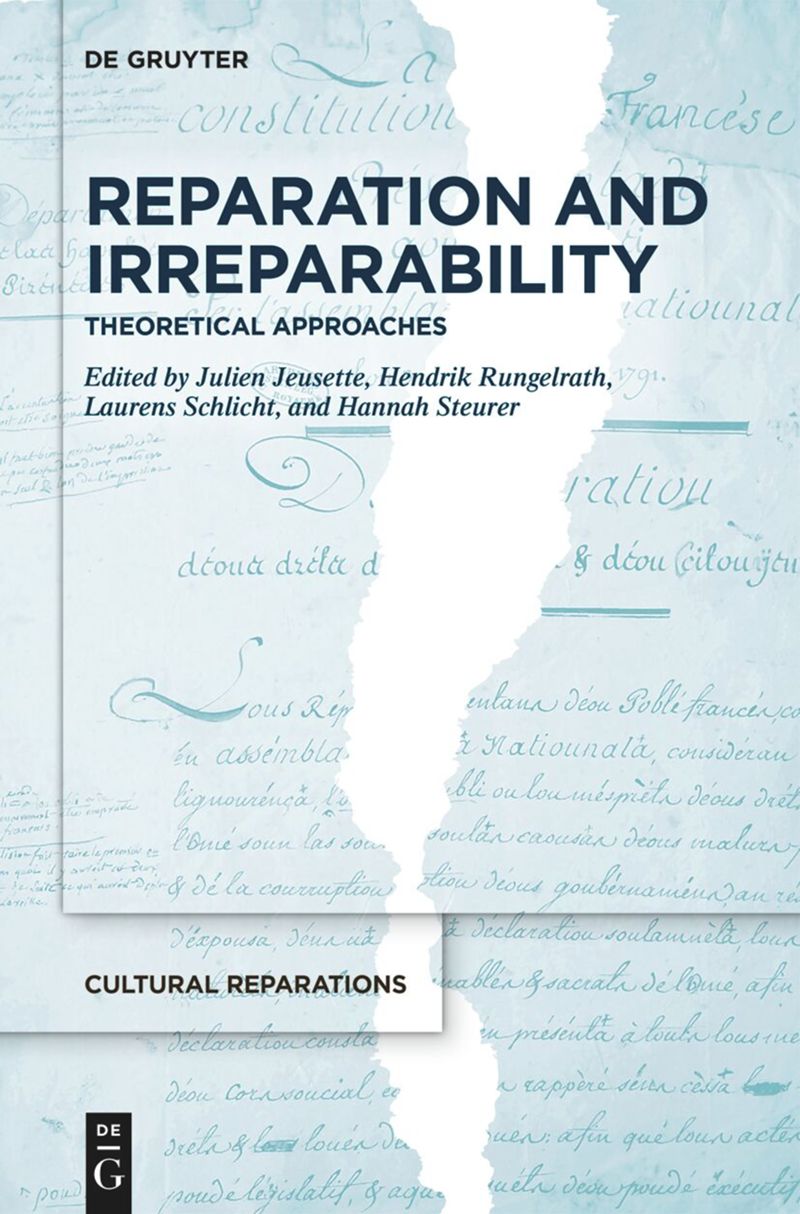
Vol. 1: “Reparation and Irreparability” Theoretical Approaches
Julien Jeusette, Hendrik Rungelrath, Laurens Schlicht, Hannah Steurer, eds.
Published in English and also containing contributions in French, this volume of proceedings from the first CURE symposium approaches cultural practices of reparation and their engagement with the irreparable from a theoretical perspective – in literature, music, translation, rituals, and other contexts. Its contributions explore responses to experiences of injury that extend beyond legal or economic forms of redress. Its aim is not to develop a unified theory of reparation, an undertaking not possible in any case, but to make visible the plurality of cultural practices and understand reparation as an ongoing, unfinished, and contested process.
Vol. 2: Shoah Dreams. Narrating the Irreparable
Christiane Solte-Gresser
What can dreams teach us about the Shoah? Dreams are omnipresent in concentration camp literature. Whether appearing in documentary testimonies (Beradt, Szittya, Cayrol), autobiographical texts (Antelme, Levi, Delbo, Wiesel, Semprun), dramatic works (Fritsch, Eich), or novels (Bachmann, Langfus, Foer) – dreams each speak a language entirely their own. And yet these texts also bear witness to collective dream experiences – escapes thwarted, food denied, stories stifled, or abrupt returns to the camps. Writing dreams down and sharing them with others thus becomes a paradoxical cultural practice of reparation – a continuing engagement with what cannot be repaired.