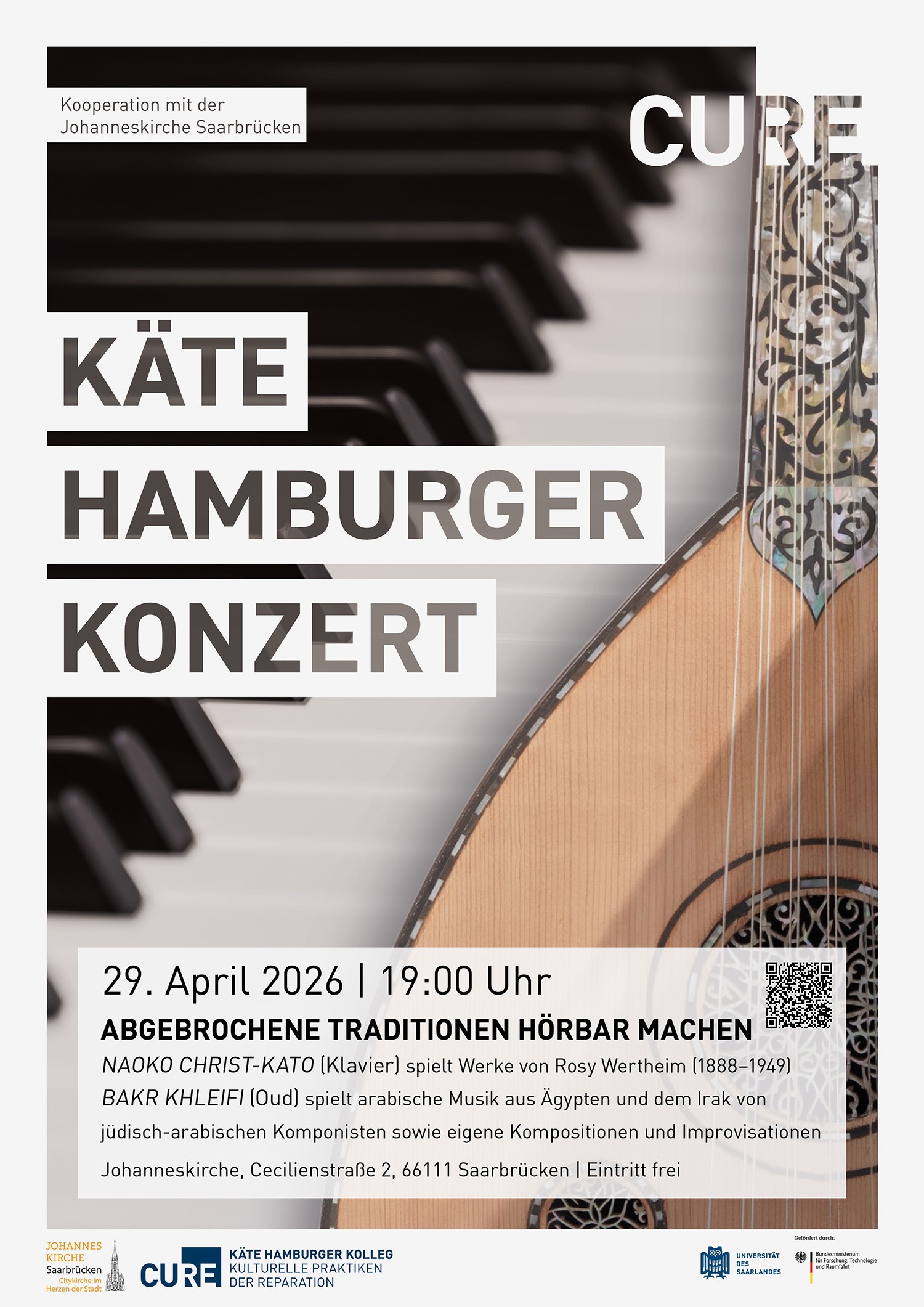
KÄTE HAMBURGER CONCERT WITH NAOKO CHRIST-KATO AND BAKR KHLEIFI
WHEN
WHERE
Johanneskirche
Cecilienstraße 2
66111 Saarbrücken
PROGRAMME
On Wednesday, 29 April at 7 p.m., the Käte Hamburger Centre for Cultural Practices of Reparation CURE will host a concert evening at the Johanneskirche in Saarbrücken, under the title “Resonance After Rupture”.
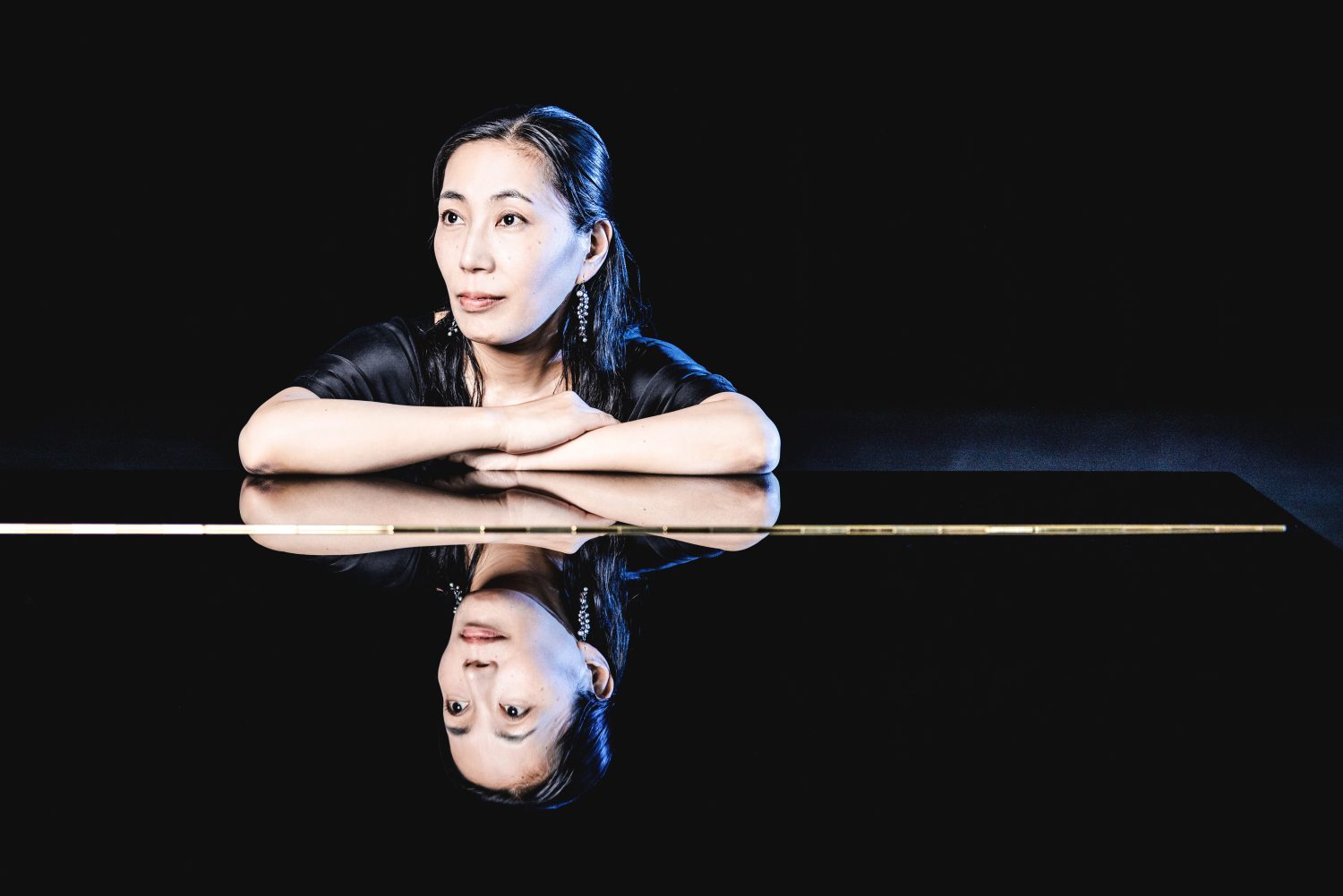
The first half of the evening features the acclaimed Japanese pianist Naoko Christ-Kato performing piano works by Rosy Wertheim (1888–1949), a Jewish composer from the Netherlands who was persecuted under National Socialism. Wertheim, who also worked in France, Austria, and the United States, returned to the Netherlands in 1937. There, she joined the resistance, went into hiding for several years, and organised secret concerts featuring banned music by Jewish composers. Although many of her family members were deported and murdered, she survived the war. Nevertheless, she was unable to rebuild her career as a composer, and her work remains largely unknown today.
Naoko Christ-Kato studied piano in Tokyo, Hanover, and Lübeck. She has won the Young Artist Piano Contest and the Best Players Contest in Japan and has held scholarships from the German Music Council and the Cultural Foundation of the Free State of Thuringia. For many years, she has been committed to rediscovering and performing music by forgotten and persecuted Jewish composers, notably as the pianist in the Gernsheim Duo with soprano Anna Gann. 2025, she released a CD featuring the world premiere recordings of works by Rosy Wertheim.
The second half of the concert will be performed by musician and composer Bakr Khleifi, who was born in Jerusalem. A Palestinian oud player, Khleifi’s work bridges traditional maqam music and contemporary composition. Drawing from the depth and versatility of Arab musical heritage, his music creates a dialogue between the oud and orchestral or chamber-music soundscapes.
Khleifi studied double bass at the Buchmann-Mehta School of Music in Tel Aviv and oud at the University of Gothenburg, where he earned a degree in world music. For several years he performed with the West–Eastern Divan Orchestra – founded by Edward Said and Daniel Barenboim – which brings together Arab and Israeli musicians in support of peace in the Middle East. Over a decade ago, he left the ensemble to pursue his own artistic path.
Today, his projects include collaborations with orchestras and ensembles exploring maqam composition in contemporary settings, alongside an expanding body of solo works for the oud. His music renews Arab musical traditions from within – rooted, distinctive, and open to dialogue with wider musical worlds.
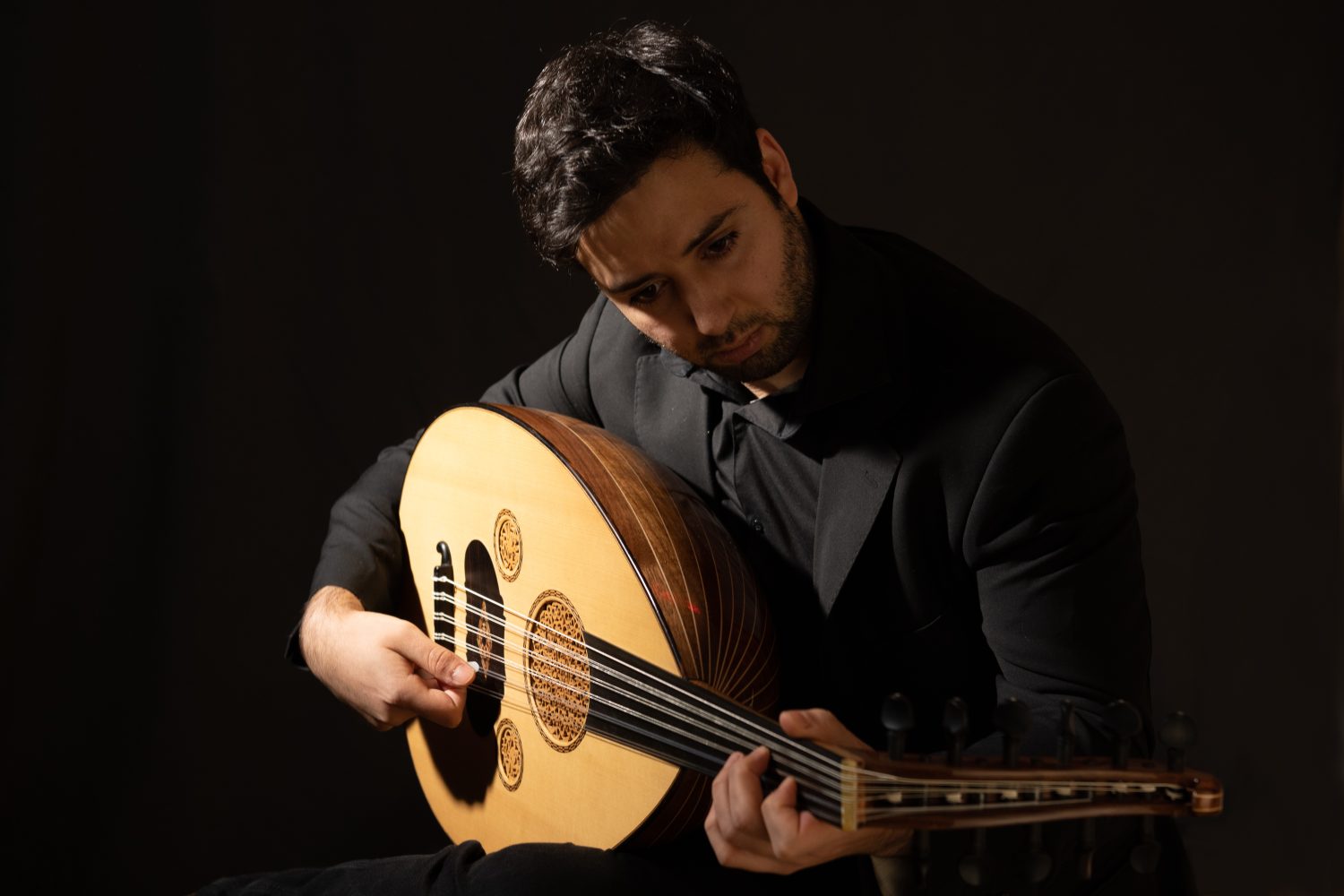
On 29 April, Khleifi will perform original compositions and improvisations for the oud – an instrument regarded as the forerunner of the European lute. It was only after the Second World War that the oud gained some recognition in Europe and the United States, and even today it remains unfamiliar to many professional musicians. Through his work, Khleifi places himself within a rich Arab musical tradition that remains underacknowledged in the West – a tradition he brings into dialogue with European musical styles in this evening’s performance.
Connecting the two parts of the programme, Khleifi will also present Arabic music from Egypt and Iraq by Jewish Arab composers – works celebrated as classics in the region but rarely heard in Europe.
The event is hosted by the Käte Hamburger Centre for Cultural Practices of Reparation CURE, under the direction of Prof. Christiane Solte-Gresser and Prof. Markus Messling. Funded by the Federal Ministry for Research, Technology and Space, the centre is devoted to cutting-edge scholarship in the humanities. With a team of permanent scholars and year-long visiting fellows from around the world, it explores cultures of memory, historical discourses, and individual experiences of loss and damage. In addition to its research activities, the centre regularly hosts cultural events. It co-organised the exhibition THE TRUE SIZE OF AFRICA with the UNESCO World Heritage Site Völklinger Hütte, collaborates with the Saarland State Theatre, and hosts film screenings, readings, and panel discussions.
Voluntary donations collected this evening will benefit the cultural centre LOSA – Maison des Arts in Kinshasa. Founded in 2020 by the artist Géraldine Tobe, the association Loboko ya Sansa (“the hand that heals”) opened Maison des Arts in October 2025 as a space for contemporary art, cultural engagement, and art therapy. LOSA supports, in particular, young local artists as well as people in clinics and assisted living facilities, and is dedicated to broadening access to artistic practice, strengthening mental health, and preserving and passing on African cultural heritage.