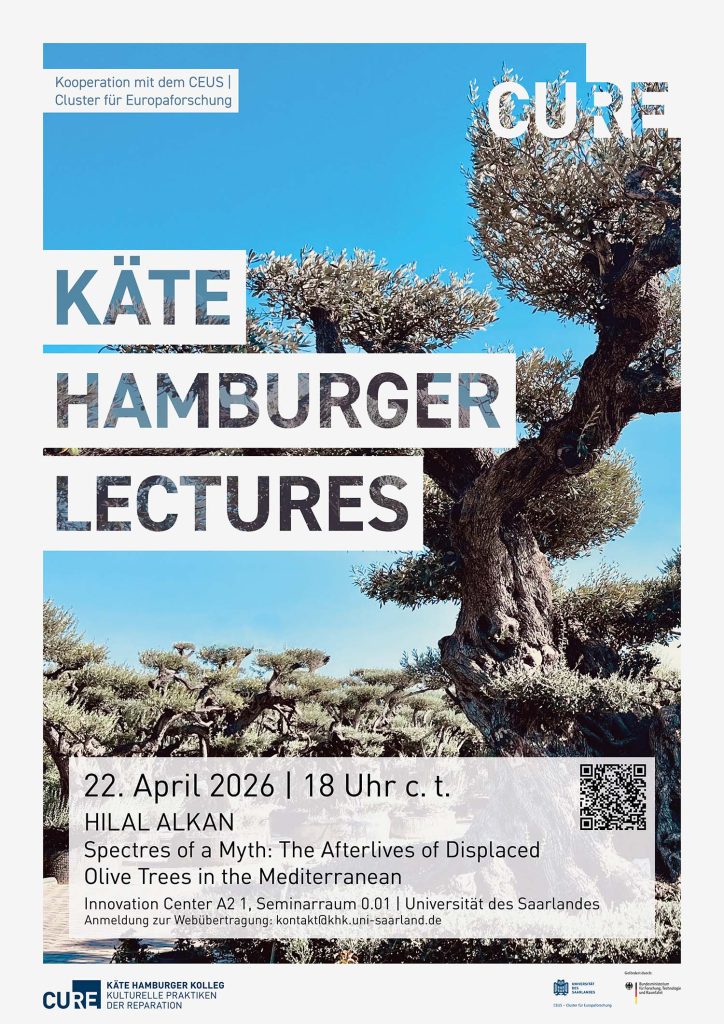
KÄTE HAMBURGER LECTURE AVEC HILAL ALKAN
QUAND
OÙ
Innovation Center A2 1, salle 0.01
Université de la Sarre
LANGUE
ANGLAIS
PROGRAMME
Le centre Käte Hamburger pour l’étude des pratiques culturelles de réparation (CURE) et le CEUS | Cluster de recherche européenne, ont le plaisir de vous inviter à la prochaine Käte Hamburger Lecture à l’université de la Sarre. Dans le cadre de cette série de manifestations, les résidentes et résidents du centre présentent l’état actuel de leur recherche sur les pratiques culturelles de réparation. Après les conférences, des discussions plus approfondies peuvent avoir lieu sous la forme d’un débat public.
Hilal Alkan: Spectres of a Myth: The Afterlives of Displaced Olive Trees in the Mediterranean
Uprooted ancient olive trees have become a prized landscaping fixture in Turkey. They are called “macro-bonsais”, grown in steel pots, with pruned and maimed limbs, their foliage carefully razed to look like trays or balls. Ghostly remainders and reminders of the bearers of the “liquid gold”, with their evergreen foliage, statuesque form and embodied stories, they now serve the wealthy, not the peasants. The processes that have led to the emergence of these lively commodities are multifold, ranging from rural abandonment to extractivist projects. Yet they also relate to the cultural production fed by contemporary olive mythologies. In her lecture, CURE fellow Hilal Alkan looks at the myths surrounding the olive, which on the one hand increases its value, as a health enhancer, an immortal witness to history and an identity marker, and on the other hand creates the market for its circulation as a looted and displaced entity—a specter of itself. Alkan asks under which circumstances the olive tree, which characterizes the Mediterranean, a region disproportionately affected by the ecological crisis and raging wars, offers a phantasmagorical remedy to heal these wounds, while at the same time being subjected to an array of violent destructions and displacements itself.
Les Käte Hamburger Lectures permettent de découvrir les recherches en cours au centre, de les partager à l’université et d’engager tous les publics intéressés dans une réflexion sur les pratiques culturelles de la réparation.
Diffusion en visio de la conférence
La conférence sera diffusée en visio sur Microsoft Teams le 22 avril à partir de18 h 00. Pour y assister, cliquez ici.