
In the space beneath Hong Kong’s Canal Road flyover, a form of reparative practice endures that speaks to distinct conceptions of harm, healing, and communal well-being. Known in Cantonese as da siu yan 打小人, a term fusing the verb da 打 (to hit or beat) with siu yan 小人 (literally “small person/people”)—the practice is often translated as “villain hitting.” The phrase siu yan carries a specific social meaning: petty, spiteful, or obstructive individuals who undermine others through gossip, scheming, or small acts of malice. The practice of da siu yan, commonly performed by elderly women, involves the beating of paper effigies with old slippers while reciting incantations, ostensibly aimed at cursing or neutralising these “petty people” believed to block fortune or progress. This is a cultural practice of cathartic reparation, where grievance is given form and direction through bodily and communal ritual, allowing resentment to be expressed, contained, and symbolically dealt with.
The custom originated in agricultural traditions in the Guangdong province, where villagers developed rituals around Jingzhe 驚蛰, the “Awakening of Insects”, the third solar term in the traditional Chinese lunisolar calendar, falling approximately in early March. During this period, hibernating creatures awaken, including what folklore identifies as the White Tiger, which was believed to destroy crops and harm villagers. To appease this force, communities would smear pig’s blood onto paper tigers as sacrifice. Over time, the tiger transformed into the figure of the siu yan, the “little person” or villain. Villain hitting was brought to Hong Kong by migrants and became established as an urban folk ritual. Designated as part of Hong Kong’s intangible cultural heritage by the Home Affairs Bureau and selected by TIME magazine in 2009 as “Best Way to Get It Off Your Chest” in their “Best of Asia” feature, it has achieved a peculiar status as both traditional custom and contemporary stress relief.1
Unlike practices conducted in temples or other sanctified sites, da siu yan thrives in the interstices of the urban landscape, in liminal spaces simultaneously public and marginal, engendered by the din of traffic and pedestrian footfall. The Canal Road flyover in Causeway Bay, where ritual specialists—typically elderly women who have learnt their craft through apprenticeship—have for decades established stalls, occupies a junction believed to be where “three evil spirits” cross, a place of abundant yin energy: the dark, cool, receptive force in Chinese cosmology associated with shadows, water, and the underworld, and thus considered potent for rituals that confront malevolent influences. This is not the air-conditioned space of official authority, but what anthropologist Michel de Certeau might recognise as a tactical appropriation of urban infrastructure, a making-do with the city’s leftover spaces. The ritual is rooted in community, accessible to anyone who can pay between HK$50 and HK$500 (€6 to €60).
The ritual typically follows a recognisable sequence, though details vary by practitioner and occasion. The specialist lights candles or incense, then prepares a paper effigy that may bear the name and birth details of a specific “villain” or stand more generally for misfortune. She strikes the effigy repeatedly with a slipper while chanting rhythmic incantations, sometimes calling on deities such as the Monkey King to overcome obstacles or a wealth spirit for prosperity.2 Chants often include verses like “Beat your little head, make your luck all dead / Beat your little hand, your good luck comes to an end / Beat your little foot, make your life no good / Beat your little eye, let you stumble till you die”, recited in Cantonese as each part of the effigy is struck. Paper offerings, including a White Tiger effigy fed with pork fat or blood, are then burned to curb harmful forces. The ritual usually concludes with the burning of red gwai yan 貴人 (“noble people”) paper to invoke the help of benefactors who will bring assistance or favourable intervention once misfortune has been driven away. A session lasts about fifteen minutes and is most popular during Jingzhe.
*
Cultural practices of reparation often seek to restore agency and affective equilibrium through symbolic action. Da siu yan operates as such a practice: while the ritual cannot undo a betrayal or reverse a lost opportunity, it repairs the client’s sense of powerlessness by providing a means to actively respond. The cursing of villains—wishing misfortune upon them through chanted incantations—channels rage and frustration into prescribed ritual form. Whether directed at a specific rival or at abstract forces such as bad luck, workplace backstabbing, malicious gossip, persistent obstacles, financial misfortune, or illness, or more diffuse negative influences, the practice offers participants a way to “strike back” against perceived injustice, restoring a sense of agency even when material circumstances remain unchanged. During the COVID-19 pandemic, for instance, clients even directed the ritual at the virus itself. The repeated striking releases tension, the burning of effigies performs symbolic retribution, and the invocation of protective forces gestures toward future advantage. Yet this repair work is not always undertaken with solemn conviction. Many participants describe the practice as knowingly excessive, humorous, or only half-believed, but cathartic nonetheless—a ritualised performance of anger that derives part of its efficacy from irony, play, and collective recognition of its theatricality.
Beyond its therapeutic dimension, da siu yan functions according to a communal rather than institutional logic. The economic structure is direct: clients pay practitioners, not institutions, and the practice sustains a form of labour typically unavailable to elderly, working-class women. This is what makes da siu yan a genuinely people-orientated, bottom-up practice—it emerges from and serves communities without mediation by institutional gatekeepers.
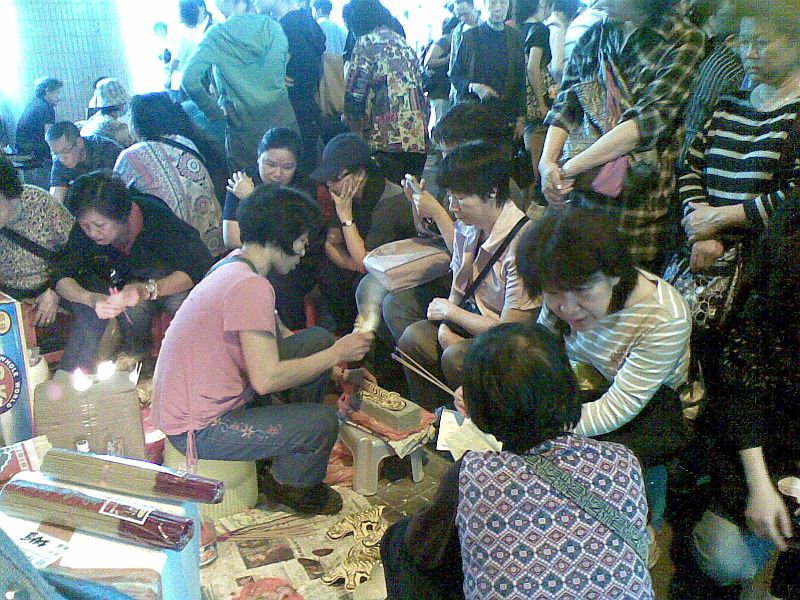
From a rationalist perspective, da siu yan may be dismissed as superstitious theatre, a holdover from agrarian society with no place in a modern financial centre. The percussive strike of shoe against paper, the invocation of spirits, and the burning of offerings to invisible forces all operate outside so called scientific empiricism and measurable causation. That da siu yan persists owes something to its unthreatening character: it takes place within established Chinese folk religious traditions, domesticated through its appeal to tourists and psychological interpretation. The women beneath the flyover work one client at a time, their service readily understood through the vernacular of stress relief and catharsis.
Da siu yan exists within a continuum of embodied, community-based practices found across cultures that address collective and individual suffering through ritualised bodily action. The San trance dance of the Kalahari, Haitian Vodou ceremonies, Indonesian Kuda Kepang, and Moroccan Gnawa lila all rely on different epistemologies: knowledge systems that privilege bodily experience, communal witnessing, and spiritual causation. Many such practices have faced or continue to face suppression: colonial authorities banned indigenous healing ceremonies, postcolonial states criminalised spirit possession rituals, and modernising projects dismissed embodied knowledge as backwards superstition.
The survival of da siu yan teaches us epistemic humility: an acknowledgment that multiple valid frameworks exist for addressing harm, restoring balance, and making meaning from suffering, even when they operate outside the logics we have been trained to recognize.
Tammy Lai-Ming Ho
1. For heritage designation, see Hong Kong Home Affairs Bureau, Intangible Cultural Heritage Inventory of Hong Kong (Hong Kong SAR Government, 2014). TIME, “Best of Asia: Best Way to Get It Off Your Chest,” TIME Asia, 2009, reflects Western media psychologisation of ritual practice.
2. On the Monkey King as a figure who undergoes reassemblage across contexts of struggle and resistance, see my earlier discussion: “The Monkey King’s Diasporic Reassemblage in Sinners,” World Literature Today 99, no. 5 (September 2025).
Tammy Lai-Ming Ho. “Beating the Villain with a Slipper: Rituals of Reparation in Urban Hong Kong”. The Reparation Blog, 26 January 2026. https://cure.uni-saarland.de/en/media-library/blog/beating-the-villain-with-a-slipper/.
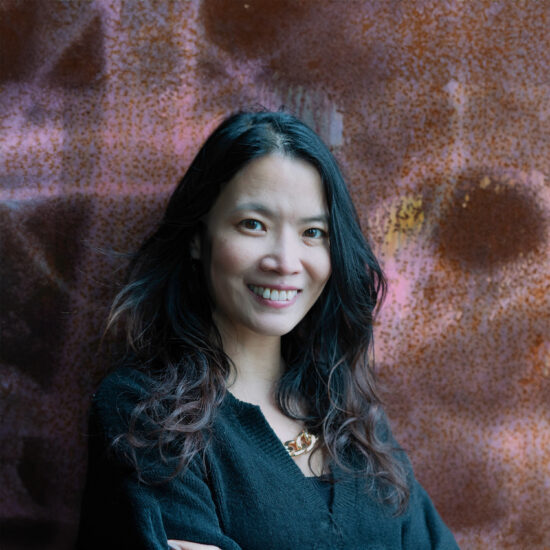
Prof. Dr. Tammy Lai-Ming Ho
Tammy Lai-Ming Ho is a Hong Kong-born scholar, poet, translator, and editor. She is the editor-in-chief of Cha: An Asian Literary Journal, a significant platform for the study and amplification of Asian voices, and co-editor of Hong Kong Studies, the only peer-reviewed journal focused on Hong Kong. She also serves as English Editor of Voice & Verse Poetry Magazine and Translation Editor of The Shanghai Literary Review. A former tenured Associate Professor at Hong Kong Baptist University, her academic work includes the monograph Neo-Victorian Cannibalism (2019) and articles on Hong Kong literature and culture. Tammy has co-edited anthologies such as Desde Hong Kong: Poets in Conversation with Octavio Paz (2014), Twin Cities: An Anthology of Twin Cinema from Singapore and Hong Kong (2017), and Hong Kong 20/20: Reflections on a Borrowed Place (2017). Her poetry collections include Hula Hooping (2015), which won the Young Artist Award in Literary Arts, Too Too Too Too (2018), and If I Do Not Reply (2024). In 2023, she was writer-in-residence at the International Writing Program at the University of Iowa. For her updated biography, visit tammyholaiming.com.