
Te levantas con la
herida de la amnesia
Jorge Aguilar Mora, Stabat Mater
Three years ago, I watched Trasiego (Amanda Woolrich, 2023) for the first timethrough a link shared with me by the director.1 My attention was immediately grabbed by the striking visuals – various animal skulls, animated with charcoal and ink, in a dark process of mutation – and the rejection of the belief that a person dies only once and that is the end of their story. However, at the film’s first screening in Germany in 2025 during the workshop The Politics of Literature between East-Central Europe and Latin America, organised by Agnieszka Hudzik and José Luis Nogales Baena at the University of Saarland, I realised the importance of the film’s dialogues; the exchanges between a grandmother (the visual artist Fanny Rabel) and her grandchild, the visual artist Amanda Woolrich, lie at the heart of Trasiego (Decanting).
After the screening, Woolrich gave a talk and shared more context about the creative process behind her short film. This information opened my eyes to how important memory and healing are for Trasiego, and how this animated short film can be read as a cultural practice of reparation.
***
The Polish Mexican visual artist Fanny Rabel passed away in 2008. Four years after her death, the Iberoamericana University reached out to Rabel’s family to create an archive not only of Fanny’s work, but also of her personal documents. In the 1940s, Rabel fled her native Poland and arrived in Mexico, where she studied with Frida Kahlo and Diego Rivera, becoming an active participant in the muralist movement.
In 2021, Amanda Woolrich came across some of her grandmother’s “intimate notebooks” while organising her archive. Woolrich writes: “As I read them, I began to find drawings of spaces and thoughts similar to those I had produced in some of my own notebooks. I began to read both of them side by side and it seemed that they were reaching agreements and interacting, even though they spoke of different realities.”2
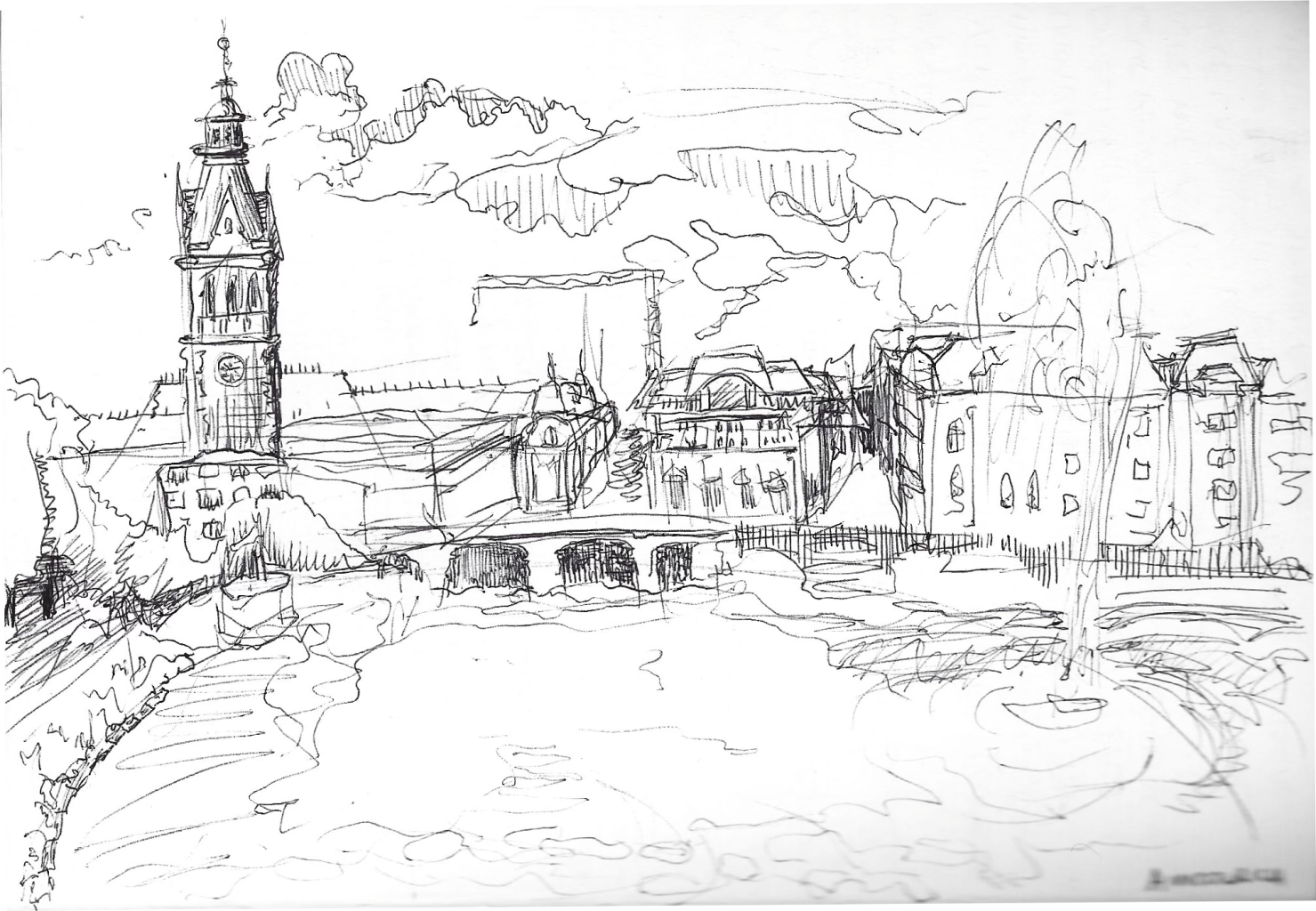
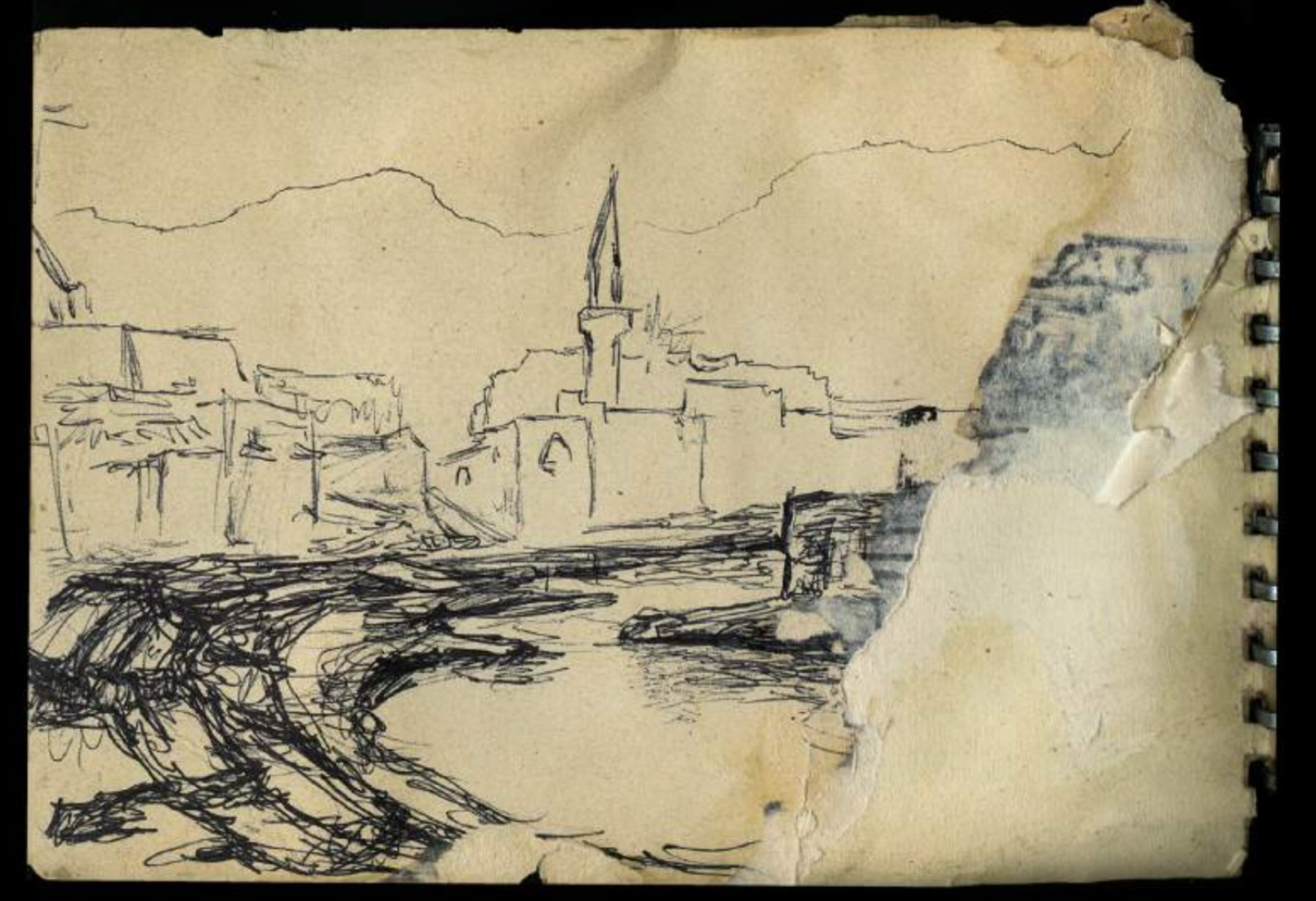
Thus, adeep artistic and intergenerational dialogue began, with experiences of violence and the works of memory playing a crucial role. In the short film, these concerns are depicted by two objects: a trunk and a chair.
The Trunk
Trasiego starts with the lugubrious intonation of various reflections on death that Fanny Rabel wrote in her notebooks. Simultaneously, the first drawing of the short film appears: a rotating trunk floating towards us through a black void. The trunk opens and it seems to be empty before it quickly sucks us into its depths. We are in Trasiego.
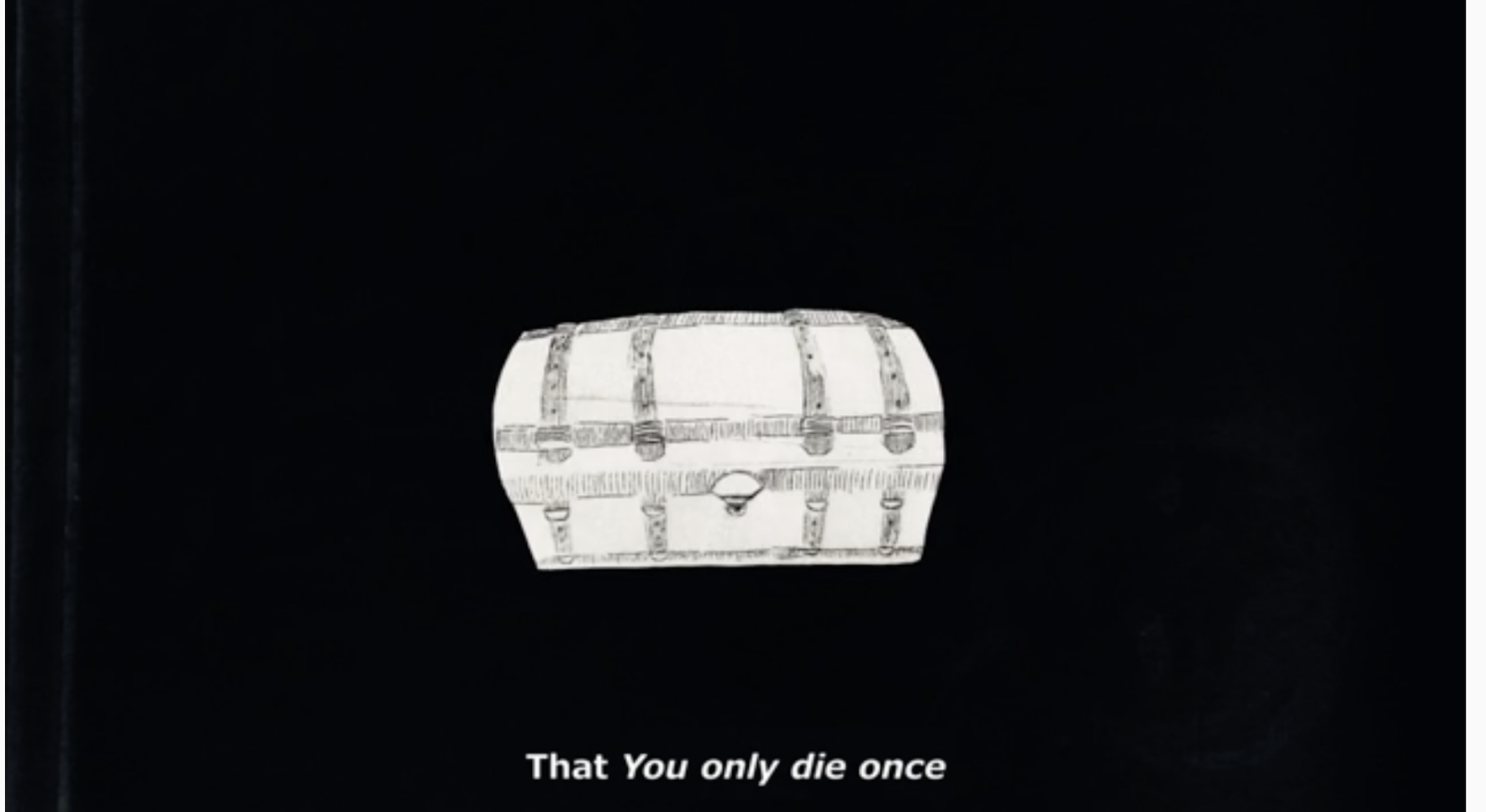
This trunk is inspired by the one Rabel used to store what she considered her most essential possessions: materials from her childhood in France, official documents for her family’s arrival in Mexico, letters from her stepbrother (who could not escape the violent tide of fascism and died in Europe), identity cards, and entry permits.
Rabel changed her last name (she was born Fanny Rabinovich), language, and identity when she arrived in Mexico. In the middle of these transformations, the trunk saved some of her and her family’s identity and past. Both Fanny and her father suffered from Alzheimer’s at the end of their lives; therefore, these material testimonies were crucial for Rabel’s genealogy. She wrote in one of her notebooks, quoted in Trasiego, that every loss in our lives is a little death of ourselves. Then, when “the final death arrives, it finds only parts of what we lived, what we were and what we have seen come to pass” (Woolrich 1:23.1:24). For this reason, according to Rabel, “we dread that final death: the loss of memory, of the matter that keeps us tied to what we know” (Woolrich 1:38–1:45).
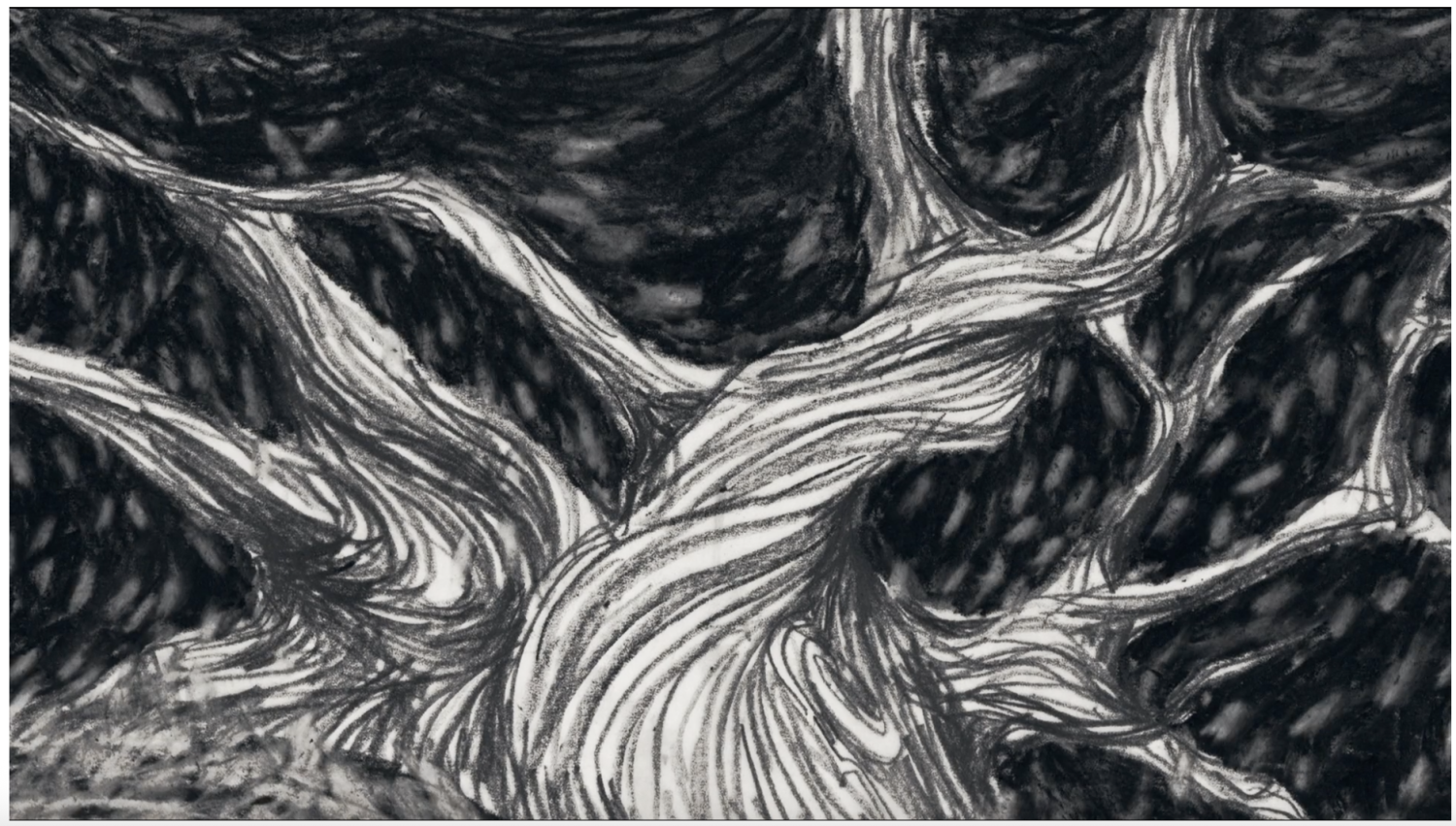
A radical loss of memory throughout our lives finds its representation in the second object evoked in the dialogue between grandmother and granddaughter.
The Chair
While the image of a chair might typically bring about feelings of comfort and relaxation, the sounds of sloshing water and eerie darkness that accompany this image in Trasiego suggest a space of torture. The chair emerges, unstable and lopsided, from a falling drop of liquid light. We hear a young voice claiming: “I can’t remember that moment clearly… my brain hides memories to protect me from the truth. As I grow older, it releases information to me, little by little, so I can bear it” (Woolrich, 4:08–4:27).
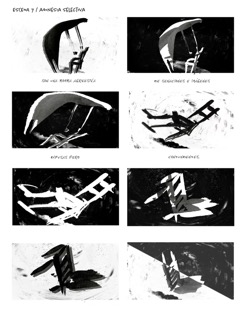
Amanda Woolrich explained that the chair scene is a creative response to her selective amnesia, product of an abuse experience she suffered when she was a child.
According to UNICEF, “globally, 650 million (or one in five) girls and women alive today have been subjected to sexual violence as children.”3 Between 2023 and 2024, several Mexican newspapers and news channels shared an alarming fact about the reality in the country: “Mexico, leader in child abuse, according to the OECD.”4 Terrible experiences happen every year in Mexico to more than 4.5 million children,5 and something is egregiously wrong in the Mexican legal system, where “only 1 per cent of the cases related to child abuse result in a guilty verdict.”6
In the chair scene from Trasiego, a sharp and shape-shifting figure threatens the defenceless chair (Woolrich 4:45–5:13), which spins, and falls, and cannot leave the dark room. A voice reiterates the impossibility of bringing an image back and remembering. After this scene, Fanny Rabbel’s drawings reappear, and the filmends with her words expressing a rejection of oblivion.
What can one do with the haunting remnants of the irreparable – the immaterial presence of amnesia and impotence, and the discomfort they bring? One has the chance to transform them.
Trasiego is a short film about transformations, a visual artefact that gives shape to a lack of memories and refuses to accept the idea that amnesia implies only impossibilities. Since its release, it has been prized for its experimental techniques and for the challenge inherent in representing absence in visual images. Amanda Woolrich’s mixed techniques transform lack – which tends to keep emotions stuck in place – into palpable and mobile possibilities.
Trying to depict an absence (of justice, of memory, of a sense of protection) can be a practice of reparation. This term refers to an effort not only to restore, but also to transform. Pain, bewilderment, and impotence – faced with a void of actions and answers – can mould itself into art. Woolrich’s work is a strong example of art as a cultural practice of reparation. She is also my beloved friend, and this reflection on her work is a form of written gratitude for her ability to trace answers, to shape justice with her own hands, and for the bravery implied in facing any kind of violence, working on it, and making it trasegar.
1. Now available on artist’s website https://www.amandawoolrich.com/animacion/trasiego.
2. Amanda Woolrich, “Trasiego” Visión de la directora sobre el corto”, accessed 19 February 2026. https://www.amandawoolrich.com/animacion/trasiego. Amanda Woolrich’s sketches are reproduced with the artist’s permission. Fanny Rabel’s sketches are part of the Paloma Woolrich and Amanda Woolrich Archive and are reproduced with Amanda Woolrich’s permission.
3. UNICEF, “Sexual Violence”, accessed 24 September 2025, https://data.unicef.org/topic/child-protection/violence/sexual-violence/#status
4. Carolina Gómez Mena, “México, primer lugar en el mundo en Abuso infantil, señala OCDE”, La Jornada, 11 March 2023, accessed 25 September 2025, https://www.jornada.com.mx/2023/03/11/politica/011n1pol; Elsi V. Ventura, “Abuso sexual infantil en México; cifras alarmantes y acciones urgentes advierte OCDE”, El Imparcial, 28 December 2024, accessed 25 September 2025, https://www.debate.com.mx/politica/mexico-numero-1-en-abuso-infantil-segun-la-ocde-camara-alta-hace-exhorto-al-ejecutivo-20241229-0054.html; and “México Tops OECD Countries in Rates of Child Abuse”, ADN News, accessed 24 September 2025, https://www.youtube.com/watch?v=kMSqFOtThIE.
5. Ventura, “Abuso sexual infantil.”
6. Gómez Mena, “México.”
Diana Rodríguez Vértiz. ““Trasiego”: The Reparations of Amnesia”. The Reparation Blog, 23 April 2026. https://cure.uni-saarland.de/en/media-library/blog/trasiego-the-reparations-of-amnesia/.
Dr. Diana María Rodríguez Vértiz
Diana Rodríguez Vértiz received a PhD in Latin American studies from the Universidad Nacional Autónoma de México, following a master’s degree in Hispanic studies at the University of Washington. From 2012 to 2021, she worked as a research assistant with Margarita León Vega at the Philology Institute at UNAM, where she collaborated on two projects about mystical experiences in Mexican poetry. At the same time, she taught the course “Literature and Criticism of Literary Production in Latin America” in the Latin American studies graduate program. Her research is focused on the poetics of the Peruvian doctor and writer Luis Hernández Camarero. Her most recent piece explores the relationship between poetry, science, and ethics in his artistic project. Currently, she is studying his poetics of healing and his conception of poetry and medicine as divine ways to cure.