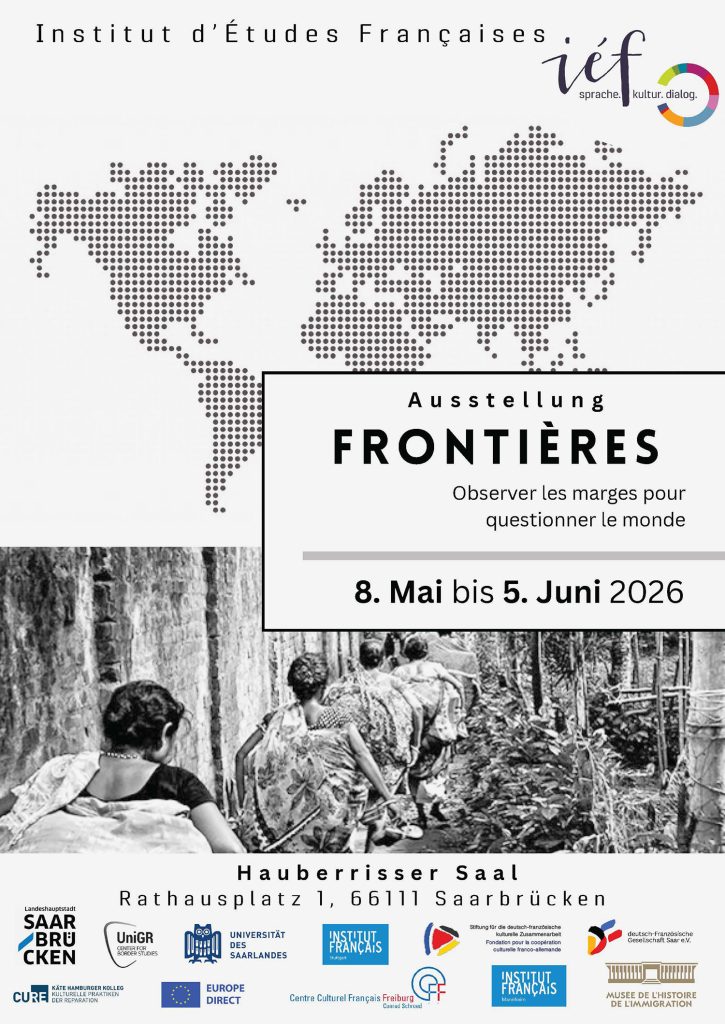
FOTO EXHIBITION
WHEN
—
WHERE
Hauberrisser Saal, Rathaus St. Johann
Rathausplatz 1, 66111 Saarbrücken
LANGUAGE
FRENCH & GERMAN
PROGRAMME
The borders of the twenty-first century are all around us – in the shadow of newly built walls, in biometric checks, in camps inhabited by people in exile, and in the everyday lives of cross-border workers. Borders are no longer simply fixed lines: they shift in response to political and economic developments and shape both individual and collective experience. Conceived by the National Museum of the History of Immigration and organised by the Institute of French Studies, this exhibition explores the borders of the twenty-first century from historical, geographical, economic, and human perspectives – moving beyond simple binaries such as openness and closure. Combining maps, photographs, and textual commentary, it interrogates the causes of growing migratory movements across all continents and highlights the diverse practices and lived realities that emerge at borders.
The exhibition texts are in French. German translations will be available for visitors in an accompanying booklet and as audio via a QR code. Opening hours: Monday to Friday, 8 a.m. to 7 p.m.
Opening event: 8 May, 6 p.m.
Hauberrisser Saal, St Johann Town Hall
At the opening on 8 May at 6 p.m., the French political scientist and migration expert Catherine Wihtol de Wenden will introduce the exhibition with a lecture entitled “Immigration and Common Conceptions About Borders”. The discussion, moderated by CURE director Markus Messling, will be held in French with simultaneous interpretation into German. A reception and opportunity for conversation will follow.
Registration and information:
culture@ief-saarbruecken.eu
The exhibition, conceived by the National Museum of the History of Immigration, is organised by the Institute of French Studies (IEF) in cooperation with the Palace of the Golden Gate (National Museum of the History of Immigration); the Saarbrücken Office of Cultural Affairs; the Franco-German Society Saar; Saarland University; the UniGR Center for Border Studies; the French Institute Stuttgart; the French Institute Mannheim; the Franco-German Cultural Centre Freiburg; Europe Direct; and the Käte Hamburger Centre CURE.