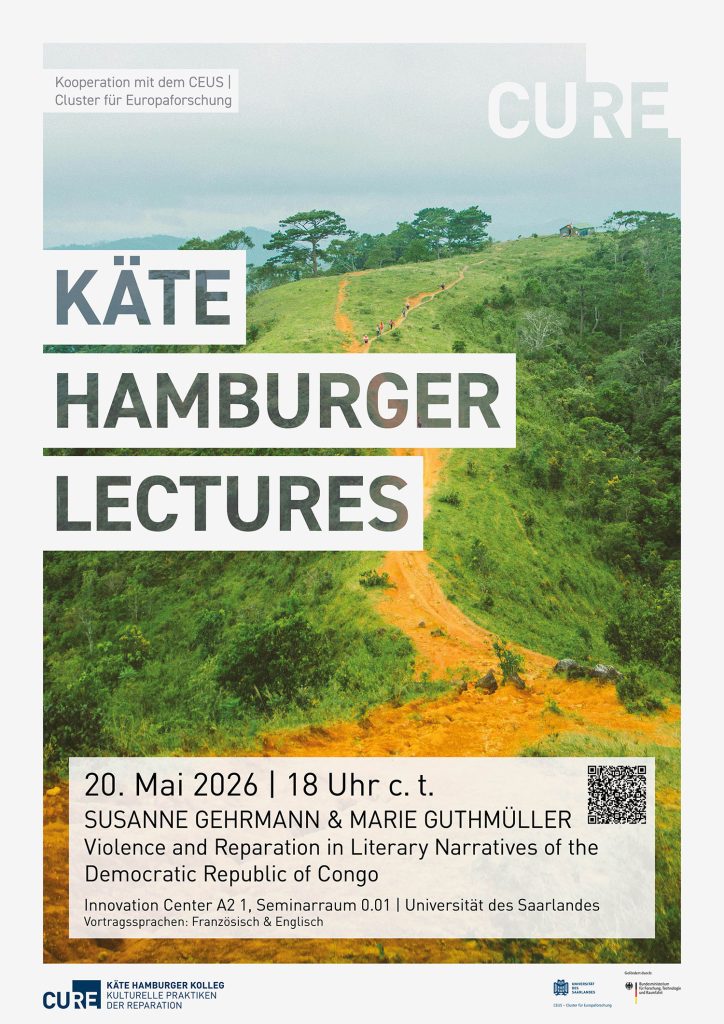
KÄTE HAMBURGER LECTURE WITH SUSANNE GEHRMANN AND MARIE GUTHMÜLLER
WHEN
WHERE
Innovation Center A2 1, seminary room 0.01
Saarland University
LANGUAGE
ENGLISH & FRENCH
PROGRAMME
The Käte Hamburger Centre for Cultural Practices of Reparation (CURE) and the CEUS | Cluster for European Studies warmly invite you to attend the next Käte Hamburger Lecture at Saarland University. This series allows fellows from the centre to share their latest research perspectives on cultural practices of reparation. After the lectures, audience members will have the opportunity to engage with key topics in more detail during a public discussion session.
Susanne Gehrmann & Marie Guthmüller:
Violence and Reparation in Literary Narratives of the Democratic Republic of Congo |
Violence et réparation dans les narrations littéraires de la République Démocratique du Congo
According to Fanon, writing on colonialism and independence struggles in 1961, violent acts necessitate reparation, but can also themselves represent a form of reparation. In contemporary decolonial debates, Kadia Attia emphasizes that the wounds of post-colonial societies cannot be healed through material aid alone: “la réparation, c’est la conscience de la blessure” (Attia 2018: 34). It is this consciousness that inspires artistic approaches to explore the (im)possibilities of collective and individual repair. In this context, we examine the literary production of today’s Democratic Republic of Congo (formerly Congo Free State – Belgian Congo – Republic of Congo – Zaïre) and its diaspora. The history of the resourceful Congo has been marked by violent ruptures and regimes in the wake of colonialism, extractivism, decolonization, postcolonial cleptocratic dictatorship, counter-rebellions and not least by the structural violence that all of these imply.
Our readings of two different, yet interconnected, corpora reveal that the experience of violence is expressed differently in locally published literature compared to the globally better-known literature of the diaspora; in terms of content, form, and rhetoric. Texts are shaped by the place of their enunciation, the literary fields in which the authors are involved, and the target audience they address. These factors also affect the conceptualization of reparation processes. In our talk we strive to relate and compare the narratives of violence that have emerged locally in Kinshasa, Lubumbashi, and Goma to those of the Congolese diaspora publishing in the Global North, and demonstrate which (im)possibilities of reparation and healing processes literature proposes.
Selon Fanon, qui s’exprimait en 1961 sur le colonialisme et les luttes pour l’indépendance, les actes de violence exigeaient non seulement réparation, mais pouvaient aussi constituer en eux-mêmes une forme de réparation. Dans les débats décoloniaux contemporains, Kadia Attia souligne que les blessures des sociétés postcoloniales ne peuvent être guéries par la seule aide matérielle : « la réparation, c’est la conscience de la blessure » (Attia 2018 : 34). C’est cette prise de conscience qui inspire les approches artistiques visant à explorer les (im)possibilités d’une réparation collective et individuelle. Dans ce contexte, nous examinons la production littéraire de l’actuelle République démocratique du Congo (anciennement État libre du Congo – Congo belge – République du Congo – Zaïre) et de sa diaspora. L’histoire du Congo, riche en ressources, a été marquée par des ruptures violentes et des régimes successifs dans le sillage du colonialisme, de l’extractivisme, de la décolonisation, de la dictature kleptocratique postcoloniale, des contre-rébellions et par la violence structurelle que tout cela implique.
Nos lectures de deux corpus différents, mais interconnectés, révèlent que l’expérience de la violence s’exprime différemment tant en termes de contenu, de forme que de rhétorique dans la littérature publiée localement par rapport à la littérature de la diaspora, mieux connue à l’échelle mondiale. Les textes sont façonnés par le lieu de leur énonciation, les champs littéraires dans lesquels les auteurs s’inscrivent et le public cible auquel ils s’adressent. Ces facteurs influencent également la conceptualisation des processus de réparation. Dans notre intervention, nous nous efforçons de mettre en relation et de comparer les récits de violence qui ont émergé localement à Kinshasa, Lubumbashi et Goma avec ceux de la diaspora congolaise publiant dans les pays du Nord, et de montrer quelles (im)possibilités de processus de réparation et de guérison la littérature propose.
The lecture will be delivered in two languages (English and French).
The Käte Hamburger Lectures provide deeper insight into the centre’s ongoing research, convey these ideas to the wider university community, and invite the public to engage in meaningful discussions on cultural practices of reparation.
Live Lecture Broadcast
The lecture will be broadcast live via Microsoft Teams on 20 May starting at 6:00 p.m. with the lecture starting no later than 6:15 p.m. You can find the link for online participation here.