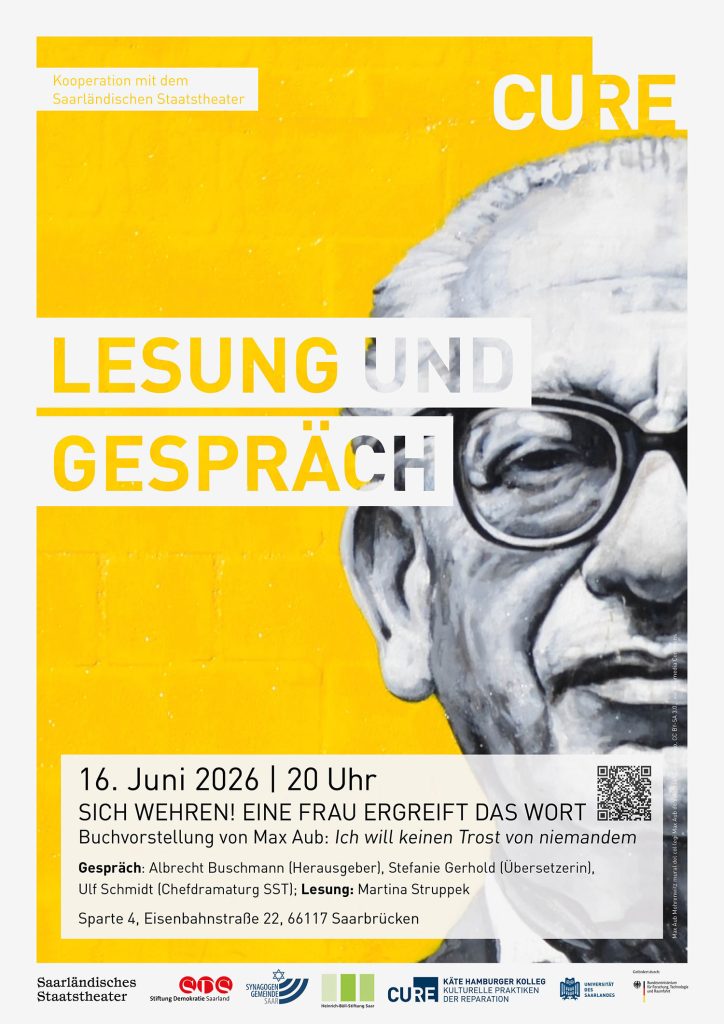
Book presentation of Max Aub’s Ich will keinen Trost von niemandem
WHEN
WHERE
Sparte 4
Eisenbahnstraße 22
66117 Saarbrücken
LANGUE
GERMAN
PROGRAMME
What can be done when a dictatorship violently abolishes democracy? This was the question facing Spanish writer Max Aub (1903–1972) when, after fleeing Franco’s Spain, he wrote a theatrical monologue in Parisian exile about the so-called annexation of Austria in 1938. The play, Ich will keinen Trost von niemandem (Let no one comfort me), is now available in German translation for the first time. Introducing the play and its historical contexts, Albrecht Buschmann (editor) and Stefanie Gerhold (translator and editor) will also discuss its relevance today with Ulf Schmidt (chief dramaturge, SST). To give the audience a sense of the text’s poetic power, the actor Martina Struppek will read excerpts from the monologue.
Discussion: Albrecht Buschmann (editor), Stefanie Gerhold (translator), Ulf Schmidt (chief dramaturge, Saarländisches Staatstheater); reading by Martina Struppe
About the play
Vienna, 1938, after the “annexation” of Austria. Emma, a Jewish woman, has had her flat expropriated and is now merely tolerated in the attic of her own building, scraping by as a cleaner at a theatre. As an unwilling witness to history, she sees how neighbours who were once friendly suddenly prove capable of brutal cruelty. Gradually, her grief for her husband Arnolf, murdered in Dachau, and for the unexplained death of her son Samuel in Spain turns into cold anger – and this once wholly unpolitical woman begins to resist.
Max Aub – the son of German French parents, a Jewish writer and dramatist born in Paris and raised in Spain – wrote this monologue in Spanish in Paris in 1939 while fleeing the Nazis, preserving it through the years of war and internment before taking it with him into Mexican exile. Both moving and clear-sightedly prophetic, the text shows how swiftly hatred and relentless incitement can make it impossible to live a dignified life.
About the author
Max Aub Mohrenwitz was born in Paris on 2 June 1903, the elder of two children of the German businessman Friedrich Aub and the Frenchwoman Susanne Mohrenwitz; his parents’ Jewish background played no role in everyday family life. At the outbreak of the First World War, the family had to leave France and moved to Spain. Valencia, where Aub completed school in 1920, became his chosen home. He initially travelled through Spain as a commercial representative, began writing, and sought contact with literary circles in Barcelona and Madrid. Aub became a Spanish citizen in 1924, and his first books appeared around this time. Following the proclamation of the Spanish Republic in 1931, he emerged as a dramatist and theatre director. At the start of the Civil War in 1936, he went to Paris as a cultural attaché, where he commissioned Pablo Picasso to paint Guernica, which was first exhibited in the Spanish Republic’s pavilion at the 1937 Paris World’s Fair. After the outbreak of the Second World War, he was interned several times in French concentration camps, including in North Africa, until he managed to escape and cross to Mexico in 1942. Aub’s wife and three daughters were not able to leave Spain and join him in Mexico until 1946. In exile, he took on a wide range of jobs to earn a living, working for newspapers, film studios, and the National Autonomous University of Mexico, UNAM. He became a Mexican citizen in 1955. This was followed by numerous journeys to the United States, Europe, and Israel, where in 1966/67 he helped to establish the Institute for Latin American Literature at the Hebrew University in Jerusalem. He was not allowed to return to Spanish soil until 1969.
Repeated experiences of flight, as well as the violent history of the twentieth century, shaped Aub’s life and literary work. While his early one-act plays were still rooted in the classical avant-gardes, he later became a realist narrator, with the Spanish Civil War as his central theme; he devoted the six-part novel cycle The Magical Labyrinth to this subject. His oeuvre includes poems, essays, experimental texts, and numerous novels, short stories, and plays. Max Aub died in Mexico City on 22 July 1972.
The editors
Albrecht Buschmann (b. 1964) is professor of Spanish and French literature and cultural studies at the University of Rostock and is currently a fellow at the Käte Hamburger Centre CURE. Together with Stefanie Gerhold, he translated Max Aub’s novel cycle Das magische Labyrinth (Translation Prize of the Spanish Embassy, 2003). His research focuses on the cultural history of literary translation, the literary representation of experiences of violence, and the literature of republican exile. He lives in Berlin.
The translator
Stefanie Gerhold (b. 1967) is a writer and translator. She has translated numerous works of prose and drama from Spanish into German. Together with Albrecht Buschmann, she received the Translation Prize of the Spanish Embassy in 2003 for their translation of Max Aub’s novel cycle Das magische Labyrinth. In 2023, her translation of Juan Mayorga’s play Himmelweg was awarded the Eurodram Prize. Her own writing includes essays on literary translation, the radio play Come Back (DRadioKultur, 2013), and the novel Das Lächeln der Königin (Galiani, 2024). In 2025, she received the Adalbert Stifter Scholarship. She lives in Berlin.
In cooperation with the Saarländischen Staatstheater, and co-organised by Stiftung Demokratie Saarland, Synagogengemeinde Saar, Heinrich Böll Stiftung Saar, and the Department of Romance Languages and Literatures at Saarland University.
Advance tickets are available here.