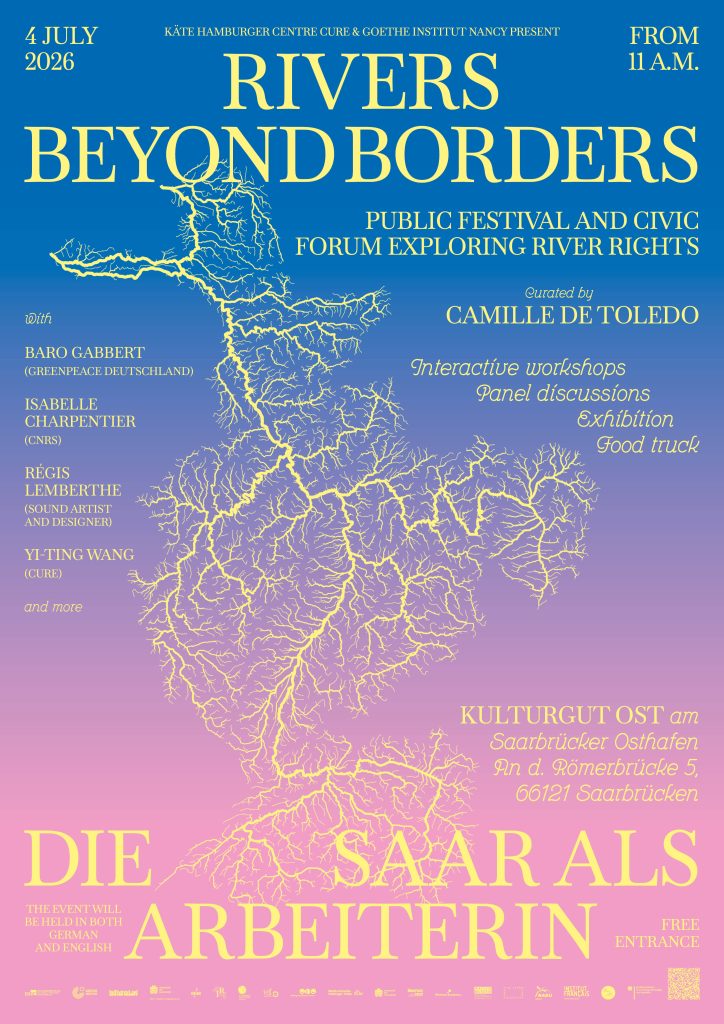
Public Festival and Civic Forum Exploring River Rights
WHEN
WHERE
Kulturgut Ost,
An d. Römerbrücke 5,
66121 Saarbrücken
LANGUAGE
GERMAN & ENGLISH
PROGRAMME
Can rivers have rights? In 2017, this question received a resounding yes when the Whanganui River in New Zealand was granted legal personhood. Across the globe, there is a growing movement to recognise the rights of natural beings in law. Could this be a way to reshape our relationship with the environment – in ways that are life-sustaining and just?
On 4 July 2026, these and related questions will take centre stage at a public forum at Kulturgut Ost in Saarbrücken, with a special invitation to people from Saarbrücken and the wider Grande Région. Writer, philosopher, and curator Camille de Toledo – co-founder of the International of Rivers – will open the day with a keynote address. Workshops and panel discussions will follow, offering a space for dialogue between representatives from politics, civil society, academia, and the arts. Together, we will ask: What would it mean to treat rivers as actors and legal subjects within our societies? What kind of future do we want to create? How might we rethink our relationship with nature?
The Käte Hamburger Centre CURE warmly invites members of the public to take part in this civic forum.
PROGRAMME
11:00–11:30 a.m. Welcome | German
Sima Reinisch (Goethe-Institut Nancy) and PD Dr Laurens Schlicht (Käte Hamburger Centre CURE at Saarland University) open the civic forum.
Welcoming remarks
Barbara Meyer, mayor of the state capital Saarbrücken
Prof Dr Ludger Santen, president of Saarland University
11:30–12:00 p.m. Camille de Toledo: A short history of the rights of nature | German/English
The idea that rivers, forests, and ecosystems can have rights of their own – and can also act in society as “ecological persons” – is gaining significance worldwide. The philosopher, writer, and curator Camille de Toledo traces the emergence of this idea and asks what cultural, political, and legal changes it entails. His lecture introduces the history of the rights of nature and examines their significance for current debates on an “ecocentric democracy” that includes other-than-human forms of life.
12:00–12:15 p.m. Presentation of the workshops | German/English
Together with the workshop ambassadors, visitors are invited to learn more about the planned activities and register for workshops they would like to attend after the lunch break.
12:15–1:15 p.m. Shared lunch break, conversation, and informal encounters
During the lunch break, a number of food trucks will offer refreshments for purchase. This shared pause will offer an opportunity to talk, exchange impressions, and make new connections. In a relaxed atmosphere, participants and contributors can begin the day at Kulturgut Ost together with a celebration of the “rights of nature” and the “rights of the living”.
1:30–3:00 p.m. Workshops
Four workshops open up new ways to explore the Saar: as a living being; as a site for developing a new relation to the world as a “biotic community”; as a space of memory; as a political actor; and as a surface for projections of a new future. In practical, creative, theatrical, and digital programming that encourages participants to imagine future forms of life, the workshops offer new perspectives on river rights, ecological justice, and the relationships between humans, nature, and democratic participation.
WORKING SAARϷ | German/English
In “WORKING SAARϷ – The River as Worker”, Régis Lemberthe asks: what happens when a river is granted rights, allowing it to express the needs and values of its “working body”? In the form of an imagined future, and echoing the scenario developed by Camille de Toledo in his book L’Internationale des rivières, the workshop allows participants to step into the role of the Saar as a “river-person” and test out new ideas for its future. Working together, participants will explore possible scenarios for the river’s ecological responsibility and economic agency, and its ability to cooperate across borders. The workshop combines speculative and political thinking with the power of imagination to explore possible future developments and transformations.
I AM THE SAAR! | German/English/French
This writing and theatre workshop with Laurent Barthel focuses on our relationship with the Saar, the rights of rivers, and the question of the future we share with them. The Saar is not silent: to those who take the time to look and listen, it tells stories – its own stories, those of the landscapes through which it flows, and those of the people who have lived on its banks and shaped its history. It also continues to speak within us, often through our earliest memories, through images, sensations, and echoes of the past.
This workshop invites participants to put their impressions into words and to become the “voice of the Saar” themselves. As part of the “Global Activism” project by Weltveränderer e. V., the workshop connects the history of the Saar with worldwide movements for the rights of rivers.
GETTING TO KNOW AND UNDERSTANDING THE SAAR | German
Led by Guido Geisen, this workshop offers a practical and sensory approach to the Saar at Kulturgut Ost. Participants will explore the river and its immediate surroundings together. They will become acquainted with typical plant species, observe habitats along the banks, and discover organisms that live in and around the Saar. Close looking and shared exploration make it possible to feel the Saar not only as a body of water, but as a diverse habitat. These observation will then become the basis for further questions: what does it mean to understand a river as a living system?
GAMING FOR THE SAAR | German/English
This interactive workshop, led by Isabelle Charpentier, introduces three digital tools that present the Saar catchment area through simulations, historical reconstructions, and participatory gaming. Participants can explore flood scenarios, trace the environmental history of river landscapes, and discover – through a computer game – the connection between ecological quality and human well-being. The workshop examines how digital programmes for the public can support democratic participation in ecological decision-making processes.
3:15–5:30 p.m. Rights of nature in conversation
The afternoon panel discussions bring together scholars, legal experts, environmental practitioners, artists, and others working in the field of culture to reflect on the political, legal, and historical dimensions of river rights. The first panel focuses on the Saar and its specific regional context, while the second broadens the discussion to international debates on the rights of nature and new forms of democracy including forms of life that are more-than-human.
Together, the two panels connect local experiences with global debates about justice in the use and distribution of resources, the legal personhood of ecosystems, and democratic transformations in an age of ecological crisis.
THE SAAR AS A PLACE OF LIFE, with Helen Arling, Ralf Beil, Corinna Heyer, moderated by Michael Kipp (3:15–4:00 p.m.) | German
This panel discussion explores the Saar as a regional, ecological, industrial, and cultural space. The participants will discuss how the idea of river rights might change the way we view the Saar and its history. Perspectives from environmental law, nature conservation, industrial history, and journalism will be brought into dialogue.
THE RIVER, A VIEW FROM THE FUTURE, with Régis Lemberthe and participants from the “Working SaarϷ” workshop (4:00–4:15 p.m.) | German/English
Régis Lemberthe and participants from the “Working SaarϷ” workshop present their “views from the future”: scenarios and projects developed in the workshop by expanding the imaginative possibilities bound up with the Saar as a “river-person” and a recognised legal person.
ON THE WAY TO AN INTERNATIONAL OF RIVERS? With Camille de Toledo and Baro Gabbert, moderated by Markus Messling (4:30–5:30 p.m.) | German/English
What would follow if we recognised rivers as bearers of rights of their own? This panel discussion examines international debates on the rights of nature and the rights of rivers. It will address different conceptions of ecological justice, new legal approaches to protecting ecosystems, and the political and democratic challenges that come with recognising rivers as legal subjects.
IN PLACE OF A CONCLUSION: A FLEETING GLIMPSE INTO AN OPEN FUTURE | German/English
With a brief look towards the future, Markus Messling bids us farewell – without any intention of offering a final word.
ALL-DAY POSITIONS
AUDIO-SLIDE SHOW “THE SAAR” | German
The audio-slide show “The Saar” will be on view throughout the day. Tracing the transformation of the Saar from a natural river into a worker in the process of industrialisation and infrastructural development, it is centred on the question of how people’s relationships with the river changed as it became increasingly industrialised and technically reshaped. Historical illustrations and photographs show different phases in the Saar’s history – from lifeline and place of work to modern infrastructure.
Michael Kipp, chief reporter at the Saarbrücker Zeitung and co-author of Die Saar im Fluss der Zeit (Geistkirch Verlag, 2020, with Robby Lorenz), comments on the images. His explanations convey perspectives on the eventful history of the Saar and on the many relationships that have developed between river, landscape, and society. Michael Kipp also asks what the relationship between human beings and the Saar might look like in the future, and what it might mean if the Saar were able to assert its rights in court.
THE SAAR’S CARRIED OBJECTS | German
This presentation by CleanUp Saarland e. V. and Yi-Ting Wang shows a selection of objects collected during a river walk organised by Yi-Ting Wang in collaboration with CleanUp Saarland e. V. During the walk, waste found in and along the Saar was documented and classified. The objects presented here offer insights into various forms of pollution in the river space and make visible how human interventions shape the Saar’s environment. They also illustrate the importance of civic engagement in protecting and caring for river landscapes.
CONTRIBUTORS
Concept and realisation
Concept and artistic direction: Camille de Toledo, writer, founder of the International of Rivers (L’Internationale des rivières), artist in residence at the Käte Hamburger Centre CURE at Saarland University, affiliated scholar at the Institut d’études avancées, Nantes
Under the overall responsibility of Markus Messling, director, Käte Hamburger Centre CURE at Saarland University
Project coordination: Laurens Schlicht, Käte Hamburger Centre CURE at Saarland University
Coordination of the overarching project “Rivers Beyond Borders”: Sima Reinisch, director, Goethe-Institut, Nancy
Scenography: Leonie Zebe
Workshops
Laurent Barthel, Weltveränderer e. V.
Dr Isabelle Charpentier, CNRS
Yolia Charpentier, Master AMINJ, University of Metz
Romain Présent, ICube, Strasbourg
Guido Geisen, environmental and herbal educator, NABU Saarland
Régis Lemberthe, sound artist and designer, Berlin
Panel discussions
Helen Arling, jurist, Trier
Ralf Beil, general director, UNESCO World Heritage Site Völklingen Ironworks
Baro Gabbert, Greenpeace, spokesperson for socio-ecological justice
Corinna Heyer, state chair, NABU Saarland
Michael Kipp, chief reporter, Saarbrücker Zeitung
Markus Messling, director of the Käte Hamburger Centre CURE at Saarland University
Camille de Toledo, writer, founder of the International of Rivers (L’Internationale des rivières)
Artistic positions
CleanUp Saarland e. V., Saarbrücken
Yi-Ting Wang, Käte Hamburger Centre CURE at Saarland University
Michael Kipp, chief reporter, Saarbrücker Zeitung
IN COOPERATION WITH
Bourges 2028, Bureau du Livre – Institut français Deutschland,, Cluster für Europaforschung (CEUS), Goethe Institut Nancy, Die Weltveränderer, HEAR – Haute école des arts du Rhin im Rahmen des Festival du Rhin, des fleuves et des rivières, Haus der Nachhaltigkeit Saarbrücken, L’Institut d’études avancées de Nantes, Institut d’Études Françaises, Kulturgut Ost, NABU, Sektor Heimat, Musée national d’histoire naturelle Luxembourg – Naturmusée, Stiftung Demokratie Saarland, UNESCO Weltkulturerbe Völklinger Hütte, Universität des Saarlandes.